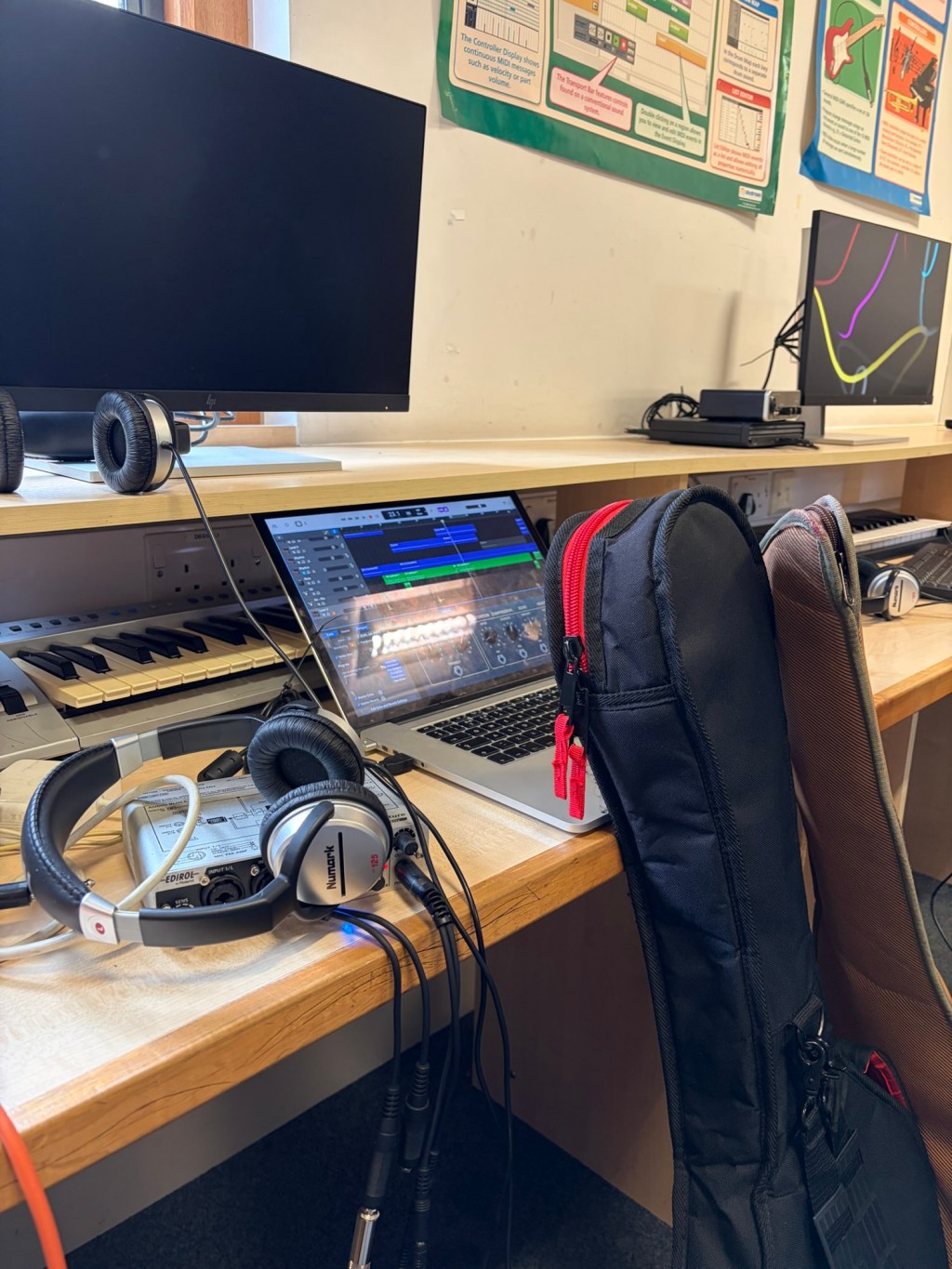
Over the Easter break, I decided to earmark a couple of days and invite my Year 11 students into school to work on their compositions. The timing made this a valuable opportunity to support them ahead of upcoming deadlines, allowing for timely intervention and more considered feedback.
Take-up was good. Many students came in, keen to make the most of a productive environment, dedicated space, and the opportunity for one-to-one support. I expected it to be useful. What I hadn’t anticipated, however, was that it would lead to some of the most effective and enjoyable musical teaching moments I’ve experienced this year. It has left me reflecting on the transformative impact of TIME when composing.
The shift from a typical hour-long lesson to a full day was profound, not simply in the quantity of time available, but in how that time was experienced. Without the pressure of the clock, the work unfolded differently: more thoughtfully, with greater depth and intent. Musical ideas were tested, reshaped, and challenged in real time. I was able to spend as long as needed with each student, offering feedback, modelling ideas, and responding carefully without the usual sense of needing to “get round” everyone. There was something genuinely exciting about these deeper musical conversations, and then witnessing students’ work evolve in direct (and indirect!) response.
The nature of scaffolding shifted too. It became more responsive and more sustained, less about guiding students towards a timed outcome, and more about supporting an ongoing process. What emerged were not just completed pieces, but evolving musical conversations and students taking real pride over their progress.
Students weren’t simply completing tasks; they were thinking like composers. Questioning, refining, responding. The dialogue moved fluidly between sound and language, between instinct and intention. A continuous shaping and reshaping that simply isn’t possible within shorter, segmented lessons.
In that extended space, composition felt less like a classroom task and more like a lived experience. Fully immersive. Entirely musical. It prompted in me, once again, a reflection on how our music qualifications are structured, particularly in comparison to art. While I value the time spent on theory and historical context, the idea of a qualification where this kind of sustained music-making sits more centrally is compelling.
Of course, it is no revelation that more time enables more progress and more meaningful intervention. But it has made me question whether I should be creating more space for composing, both at Key Stage 3 and Key Stage 4. The challenge now is how to build in longer, uninterrupted periods of creative work more regularly, so that this depth of thinking and musical engagement is not the exception, but the norm.


Leave a Reply